← All topics
NewsCafe / The reading roomWinnipeg, Manitoba · Dossier 01

A world story. A local conversation.

Gaza.
Beyond the headline.

Before we take a position, let’s make room for history, evidence and the people whose lives are at stake.

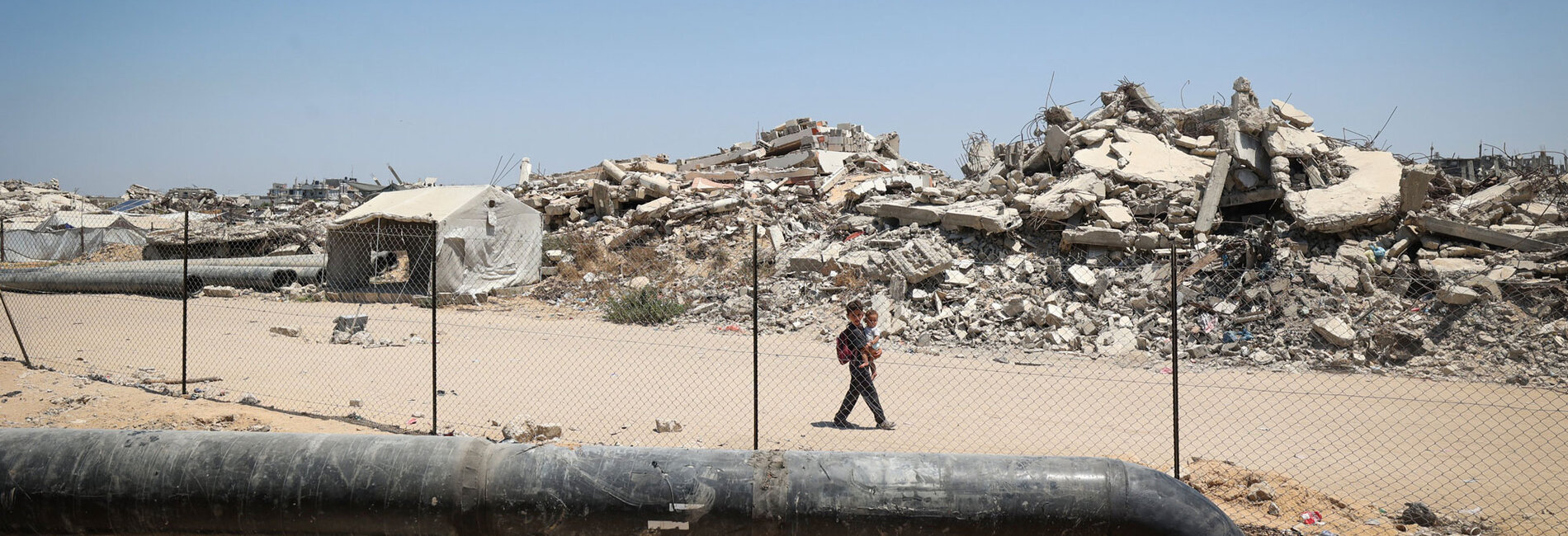
Children walking beside damaged wastewater infrastructure under repair in Gaza
Infrastructure is a human story. Photo: UNICEF, published by OCHA in its September 2026 report. Photo context ↗
Research prototype · Edition 13 September 2026. A curated, AI-assisted synthesis of linked public sources—not original field reporting or a live news feed. Figures retain their own observation dates. Covers war, displacement and hostage-taking; no graphic imagery. Café events below are proposals, not bookings.

01 / The backstory

This story did not begin with your news feed.

A reading path through the history—not an exhaustive history, and not an argument that history excuses harm.

1917–1949

Two national movements. Unequal experiences of statehood.

The British Mandate placed competing national aspirations within one territory. Jewish immigration, including people fleeing Nazi persecution, and Palestinian Arab demands for independence shaped the struggle over its future. The UN proposed partition in 1947; Israel declared independence in 1948, amid a war that also involved neighbouring Arab states.

For Palestinians, the Nakba names the displacement and dispossession of 1948. Families fled or were expelled, and many became refugees. Israeli independence and Palestinian displacement are not interchangeable experiences, but both belong in the historical account. Beginning a story in 1948, 1967 or October 2023 changes what readers can see; none of those dates alone explains everything.

UN · History of the Question of Palestine ↗

1967–1993

Occupation, rights and a peace process with unfinished questions.

Israel occupied Gaza and the West Bank, including East Jerusalem, in the 1967 war. These places have distinct geographies and political histories; Gaza is not shorthand for all Palestinians. Questions of land, movement, refugees, security and self-determination became central to subsequent negotiations.

The Oslo process brought mutual recognition between Israel and the Palestine Liberation Organization and arrangements for Palestinian self-government. It did not settle borders, Jerusalem, settlements or the refugee question. A temporary administrative arrangement should not be mistaken for a completed political settlement.

UN · History of the Question of Palestine ↗

2005–2023

Withdrawal did not settle the question of control.

Israel withdrew its settlers and permanent military installations from Gaza in 2005. Hamas took control of Gaza in 2007 after conflict with Fatah; the Palestinian Authority and Hamas must not be treated as the same institution. Severe restrictions on movement and goods, imposed by Israel and also at the Egyptian border, shaped civilian life and the economy.

Whether a territory is occupied turns on effective control, not simply whether settlers remain. The ICRC considers Gaza occupied territory. Israeli security rationales and the humanitarian consequences of restrictions must each be examined against evidence and legal obligations. Neither a government nor an armed group speaks for every civilian under its authority.

UN · History of the Question of Palestine ↗ICRC on occupation ↗

7 OCT 2023 onward

Civilian protection is not conditional on identity.

Hamas-led attacks on Israel on 7 October 2023 killed civilians and involved hostage-taking. Israel’s ensuing military campaign in Gaza caused extensive civilian death, displacement and destruction. The scale, chronology and responsibility of particular incidents require their own documentation; suffering on one side does not erase suffering on the other.

International humanitarian law prohibits hostage-taking and deliberate attacks on civilians. It requires distinction, proportionality and precautions in attacks. A stated military objective does not, by itself, establish that an attack was lawful. Nor do the violations of one party remove the obligations of another.

ICRC · Law and humanitarian work ↗

2024–2026

Separate the court case from the headline about it.

South Africa brought proceedings against Israel under the Genocide Convention; Israel disputes the allegations. The ICJ’s January 2024 provisional-measures order addressed protection of rights pending proceedings, not a final finding on whether genocide occurred. A party’s accusation, an expert assessment and a court’s judgment are different kinds of authority.

The case record accessed for this edition includes a May 2026 order setting deadlines for further written pleadings. Do not treat a procedural update as a merits judgment, or assume that the absence of a final judgment establishes that conduct is lawful. Read the precise document and identify the question it actually decides.

ICJ · South Africa v. Israel ↗

02 / The data desk

Look behind the number.

Two sourced windows into daily life and recovery. Switch datasets, inspect the figures and take the source trail with you.

When getting water becomes the daily emergency

Percent of assessed households · scale 0–100%

Moderate-to-high water insecurity among assessed households, WASH Cluster Light Touch Monitoring Survey, as reported by OCHA.

What this helps us see

The reported share increased by 7 percentage points from June to early August—not 7 percent. In early August, OCHA identified overcrowding at water collection points as the most commonly reported access barrier.

What it cannot tell us

The cited report does not supply sample sizes, weighting or confidence intervals for these rounds. Changes in the assessed sample may affect comparability. These percentages cannot be converted into a count of all Gaza residents.

03 / Stakeholders & viewpoints

Not two sides. Many people, different power.

Separate people bearing the consequences from people making decisions—and from those shaping opinion at a distance. These are sourced summaries and editorial questions, not invented interviews or polling.

9 stakeholder groups

Directly affected

Palestinian civilians in Gaza

People living with displacement, damaged services and insecurity—not a single political bloc.

OCHA documents barriers to water, shelter and humanitarian assistance. These needs are evidence of lived conditions, not a survey of political preferences.

A question worth asking

Whose testimony is missing: women, children, disabled people, displaced families or those unable to leave?

Directly affected

Israeli civilians & hostage families

People affected by attacks, captivity, loss and fear—not interchangeable with the Israeli government.

The ICRC calls for humane treatment and the release of hostages. That humanitarian demand should not be read as a complete account of families’ varied political views.

A question worth asking

Can we hear personal experience without assigning every family the same position on the war?

Decision-makers

Israeli government & military

State institutions making military and access decisions and defending Israel in international proceedings.

Israel disputes South Africa’s genocide allegations. In incident reporting, OCHA also records Israeli authorities’ stated targeting rationales. A party’s explanation requires scrutiny rather than automatic acceptance.

A question worth asking

What evidence supports a stated military objective, and what civilian harm and precautions were assessed?

Decision-makers

Hamas

An armed and political organization, distinct from Palestinian civilians and the Palestinian Authority.

Canada lists Hamas as a terrorist organization and has no contact with it. Its use of violence and hostage-taking are central to accountability; explaining its role is not legitimizing its actions.

A question worth asking

How do armed control and coercion limit civilians’ agency? Do not infer popular consent from armed control.

Decision-makers

Palestinian Authority

Canada’s governmental interlocutor in Palestine, separate from Hamas.

Canada reports PA commitments to governance reform, elections and demilitarization in its recognition statement. Those are attributed commitments, not verified outcomes in this prototype.

A question worth asking

Who can authorize a future governing arrangement, and what would establish democratic legitimacy?

Institutions

Humanitarian workers & legal institutions

Aid coordination, civilian protection and adjudication are different mandates.

OCHA reports needs and access constraints; the ICRC explains humanitarian protections; the ICJ adjudicates disputes between states. Their different functions should not be flattened into one “UN opinion.”

A question worth asking

Is this source reporting observations, interpreting law, advocating action or issuing a binding decision?

Institutions

Canada & other outside governments

Diplomatic actors with policy choices and influence; not neutral spectators.

Canada states support for Palestinian self-determination alongside Israeli security and a two-state solution. Its policy statements are evidence of its position, not evidence that the position has achieved its goals.

A question worth asking

Which commitments are measurable, and whose assessment of results should Canadians consult?

Opinion-shapers

Winnipeg’s diaspora communities

Neighbours with different histories, family ties and experiences of discrimination—not representatives of foreign governments.

CMHR’s exhibition includes Palestinian Canadian testimony recorded in Winnipeg and Montréal. This prototype has not interviewed local Palestinian, Jewish, Israeli, Arab or Muslim residents and does not attribute a shared view to them.

A question worth asking

Who wants to speak, on their own terms? Who needs the option to attend quietly or not participate?

Opinion-shapers

Editors, creators & café audiences

People selecting stories, circulating images and forming opinions at a distance.

Editorial lens, not a measured audience finding: the choice of starting date, source and headline can change perceived responsibility. Visibility online is not proof of local consensus.

A question worth asking

What would change your mind? Can you trace a claim beyond the account that shared it?

Not exhaustive: Egypt, Qatar, the United States, regional governments, journalists and many civil-society movements warrant their own reporting. Local community interviews and a fuller comparison of primary statements are still needed.
04 / Facts & open questions

What is established? What is being argued?

A shared factual starting point does not require universal agreement. We distinguish documented events, attributed estimates, legal disputes and policy choices—rather than giving claims an artificial confidence score.

Documented

Canada recognized the State of Palestine on 21 September 2025.

Global Affairs Canada records the recognition and continued support for a negotiated two-state solution. Recognition does not itself settle borders or demonstrate that promised governance reforms have happened.

Global Affairs Canada · Canada–Palestine relations ↗

Documented

Civilian protection and the prohibition of hostage-taking are legal obligations.

These rules apply independently of which party is responsible for another violation. Disputes about individual incidents require evidence; the basic protections are not a popularity contest.

ICRC · Law and humanitarian work ↗

Reported estimate

Water insecurity rose across three 2026 survey rounds.

OCHA reports 84%, 90% and 91% of assessed households experiencing moderate-to-high water insecurity in June, July and early August. These are survey results, not an independently reproduced population-wide count.

OCHA · Humanitarian Situation Report ↗

Reported estimate

Reconstruction figures describe different things.

A February 2025 joint assessment estimated roughly US$30 billion in physical damage, US$19 billion in economic losses and US$53 billion in recovery needs, based on October 2023–October 2024 data. Do not add them together or present them as September 2026 totals.

World Bank · Damage, losses and needs assessment ↗

Legal dispute

Genocide allegations require precise attribution and legal context.

South Africa alleges violations of the Genocide Convention; Israel rejects the allegations. The January 2024 provisional-measures order was not a final merits ruling. Compare the parties’ submissions with the Court’s own reasoning rather than substituting one for the other.

ICJ · South Africa v. Israel ↗

Policy debate

What leverage should Canada use, and how would success be measured?

Recognition, humanitarian support, diplomacy and other policy choices raise questions about effectiveness and accountability. A useful discussion distinguishes a desired outcome from evidence that a particular policy can deliver it.

Prime Minister · Recognition of Palestine ↗

Why no live casualty counter? This prototype has no verified live feed. Reported deaths, identified deaths, missing people and estimates of indirect mortality require different definitions, dates and methods; merging them would mislead.

05 / The framing lab

Same evidence. A different first impression.

Bias can enter through selection, emphasis, language and omission. It is not proof that a statement is false—and evidence does not become equally strong just because opposing claims exist.

Teaching examples · written by NewsCafe · not published headlines

91% of assessed Gaza households face moderate-to-high water insecurity

What comes into focus

Makes the scale within the assessed sample immediately visible.

What falls outside the frame

Does not explain who was assessed, how insecurity was defined, or which barriers people face.

Check the speaker

An official statement establishes what an official says. Test factual claims separately. Ask whether the person quoted has direct knowledge, expertise or a stake in the outcome.

Check the language

Does the sentence name an actor? Does it distinguish civilians from combatants? Terms such as “terrorism,” “occupation” and “genocide” need precise usage and attribution—not a blanket ban or casual substitution.

Check yourself

Would you accept the same quality of evidence if it challenged your view? Repetition is not independent corroboration. A missing perspective is a reporting task, not permission to invent one.

06 / The Canadian lens

Why this belongs at a Winnipeg table.

Foreign policy is national. The conversations—and the responsibilities we have toward our neighbours—are local.

From a statement to accountability

Canada recognized the State of Palestine on 21 September 2025. Its stated approach links Palestinian self-determination with Israeli security and a two-state solution. The government also says Hamas must have no role in future governance. These are policy positions to scrutinize, not a conclusion that diplomacy has resolved the conflict.

A local conversation can ask useful, answerable questions: what has Canada committed to, which institution is responsible, and what public evidence would show progress? Check the date of a funding pledge, distinguish promised from delivered support, and do not treat recognition as a substitute for civilian protection.

Global Affairs Canada · Canada–Palestine relations ↗

Find your MP and their official contact details ↗

An existing local resource

Palestine Uprooted

The Canadian Museum for Human Rights’ exhibition uses objects, art and testimony to explore displacement and memory. Its oral histories include Palestinian Canadians interviewed in Winnipeg and Montréal. This offers a different encounter with the subject than a stream of breaking-news alerts.

The museum lists 27 June 2026–30 November 2028. Check its page for admission, hours and accessibility. This is an independent resource, not a NewsCafe partnership.

Explore the museum exhibition ↗

Neighbours are not proxies for governments.

Invite people to contribute voluntarily. No one should be expected to defend a state or an armed group because of ancestry or faith. Name and interrupt antisemitism, anti-Palestinian racism, Islamophobia and dehumanization. Criticism of policies is welcome; collective blame is not.

07 / From reading to gathering

Put another chair at the table.

Six programming ideas for a Winnipeg NewsCafe. Each includes an agenda, organizer needs and a concrete outcome. All are proposals: no dates, guests, bookings or partnerships are confirmed.

Curiosity is welcome. Dehumanization is not.

Make participation voluntary, offer a right to pass and a quiet space, and do not record without consent. Ask speakers how they want to be introduced. Use a moderator who can interrupt harassment, separate evidence from opinion and pause the room when needed.

Workshops · Proposed90 minutes

Read the evidence, not just the headline

A hands-on source and data literacy lab using this dossier.

Explore the session plan
  1. 15 min · Establish a shared vocabulary: report, estimate, allegation, judgment.
  2. 30 min · In small groups, trace the water figures to OCHA and identify denominators and dates.
  3. 25 min · Compare framing without changing the underlying evidence.
  4. 20 min · Build a source checklist to take home.

What organizers need

A facilitator and data-literate co-host; printed sources, accessible tables and a projector. Seek a local journalism educator; no guest is confirmed.

What people leave with

A one-page evidence checklist and a list of unresolved research questions.

Meetups · Proposed60-minute café follow-up

A museum visit, then a listening table

An optional independent visit to Palestine Uprooted, followed by careful reflection.

Explore the session plan
  1. 10 min · Explain the listening agreement and the right to pass.
  2. 20 min · What did one object or testimony reveal that a news report did not?
  3. 20 min · Separate personal response from historical claims to investigate.
  4. 10 min · Collect questions for further reading, without recording names.

What organizers need

Check CMHR hours, admission and accessibility directly. Arrange café space separately; no museum partnership is implied.

What people leave with

A reading list shaped by participants’ questions, not a vote on someone else’s lived experience.

Discussions · Proposed90 minutes

What should Canada be accountable for?

A moderated policy discussion—not a debate over anyone’s humanity.

Explore the session plan
  1. 15 min · Read the Canadian recognition statement and define its stated aims.
  2. 20 min · Identify the tools, responsibilities and limits of Canadian policy.
  3. 35 min · Compare options using explicit criteria: civilian safety, rights, feasibility and accountability.
  4. 20 min · Record areas of agreement, disagreement and missing evidence.

What organizers need

An experienced moderator, an evidence steward and a clear intervention policy. Invite contrasting policy expertise without asking neighbours to defend a government.

What people leave with

A public policy question sheet that participants may choose to send to their MP.

Action · Proposed75 minutes

Help the helpers: an organizer clinic

Turn a general wish to help into a practical, lawful and accountable plan.

Explore the session plan
  1. 15 min · Start with a need identified by a legitimate humanitarian or local community organization.
  2. 25 min · Match tasks to skills: accessibility, translation, room setup or source checking.
  3. 20 min · Define a responsible lead, timeline and how completion will be reported.
  4. 15 min · Review consent, volunteer safety and financial transparency.

What organizers need

Verify organizations and any fundraising rules before promotion. This prototype collects neither donations nor volunteer information.

What people leave with

A small task plan with an owner, a completion date and a way to verify the result.

Releases · Proposed60 minutes

The dossier, opened to questions

A proposed public editorial release and source-review evening.

Explore the session plan
  1. 15 min · Explain this edition’s sources, dates and known gaps.
  2. 20 min · Walk through one chart and one disputed claim.
  3. 15 min · Invite source-specific corrections and new reporting leads.
  4. 10 min · Agree what the next edition needs to investigate.

What organizers need

An editor or facilitator and a corrections process before launching a recurring series. No release date is booked.

What people leave with

An editorial change log with evidence attached to each proposed correction.

Entertainment · Proposed90 minutes

Culture beyond the news cycle

A proposed artist-led evening of poetry, music or film, with context and space to reflect.

Explore the session plan
  1. 15 min · Let the invited artist introduce their work in their own terms.
  2. 45 min · Performance, reading or a licensed screening.
  3. 20 min · Optional moderated conversation about memory, place and everyday life.
  4. 10 min · Share credited works and further reading.

What organizers need

Pay artists, secure performance or screening rights, provide content notes and confirm consent before publicity. No performer or film is booked.

What people leave with

An encounter with creative work, not an expectation that artists represent an entire people.

08 / Open notebook

Follow the evidence. See the gaps.

Sources accessed 13 September 2026. This prototype uses public documents and attributed reporting; it has not independently reproduced the data or conducted interviews.

Humanitarian

OCHA · Humanitarian Situation Report ↗

Report dated 4 Sep 2026; posted 8 Sep 2026

Compiles humanitarian reporting. Water figures refer to assessed households, not a census. Reporting periods vary by section; casualty figures have their own attributed sources.

Historical

UN · History of the Question of Palestine ↗

Historical overview; accessed 13 Sep 2026

Institutional historical synthesis maintained by the UN Palestinian rights division. A starting point, not a complete account of every community’s history.

Humanitarian

ICRC · Law and humanitarian work ↗

Living explainer; accessed 13 Sep 2026

Explains civilian protection, hostage-taking, occupation and humanitarian access. A legal explainer is not a verdict on an individual incident.

Legal

ICJ · South Africa v. Israel ↗

Case record; accessed 13 Sep 2026

Read orders separately from party submissions. Allegations, provisional measures and final judgments have different legal meanings.

A political statement explaining the Canadian government’s rationale and reported commitments by the Palestinian Authority. Commitments are not proof of implementation.

Local / cultural

CMHR · Palestine Uprooted ↗

Exhibition listed 27 Jun 2026–30 Nov 2028

Winnipeg museum exhibition featuring Palestinian Canadian oral histories. Independent of NewsCafe; no partnership or guest appearance is implied.

What still needs reporting

Direct interviews with affected people and Winnipeg residents; a broader comparison of Israeli and Palestinian primary statements; independent methodological review of the data; and deeper reporting on regional actors. The institutional source mix here is useful, but not a substitute for those voices.

How this edition should be used

As a starting reading pack, not a finished investigation. No viewpoint is inferred from identity, and no automated “bias score” is assigned. Recheck dated figures before sharing. Before a public café session, have an editor and subject-matter reviewer examine the dossier and establish a corrections process.

Edition 01 · Research prototype · 13 September 2026 · No live updates or local interviews included.